Updated October 30, 2026
The map this post points to is gone. Greg Mahlknecht’s cable map lived at cablemap.info. He later handed it to Network Atlas, which now redirects to Infrapedia. Don’t go to the old cablemap.info address: it now points to an unrelated site. The screenshots I mention below were already missing by 2013, so there’s nothing to click.
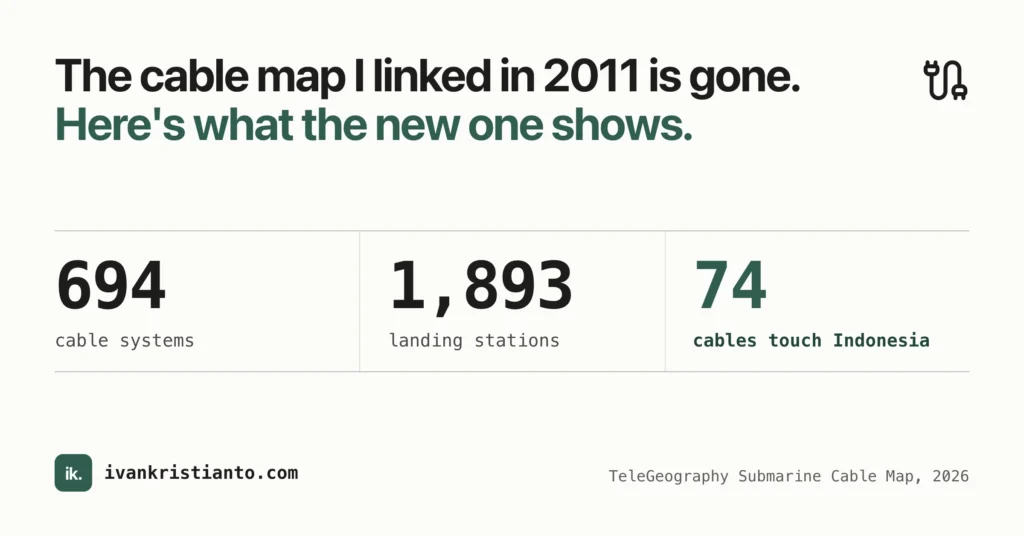
To see the undersea internet cables today, open TeleGeography’s Submarine Cable Map. It’s free. Their 2026 edition shows 694 cable systems and 1,893 landing stations. In 2018 it showed 366 systems.
What I wrote below still holds. The line you’ll see quoted is that cables carry over 99% of the data crossing between continents. TeleGeography says that’s true, though nobody can measure it precisely without satellite traffic data.
Look up Indonesia on the map and you get 74 cables, 13 of them still planned, landing at 146 points. Three of the newest are listed as ready for service in 2025, and big tech paid for them:
- Echo, Google and Meta, from the US to Tanjung Pakis and Singapore.
- Bifrost, Meta, Keppel and Telin, from the US and Mexico to Jakarta, Manado and Singapore.
- Apricot, Google, Meta and others, from Japan to Batam, Tanjung Pakis and Singapore.
Click any line on the map to see who owns it and where it lands.
Do you know that our internet uses cables (fibre optic cables) planted underwater across countries and oceans? Yes, most of our internet traffic flowing between countries travels through underwater cables. Thanks to Greg Mahlknecht for such great mapping of internet cables all over the globe and drawing it on Google Map. He used all the resources he could find online, mostly from Wikipedia. Even though he states the mapping is not exactly where the cables are, it gives you enough of a picture of how connected the online world is. See the screenshots below:
Note: Click the picture to see it in action by yourself.