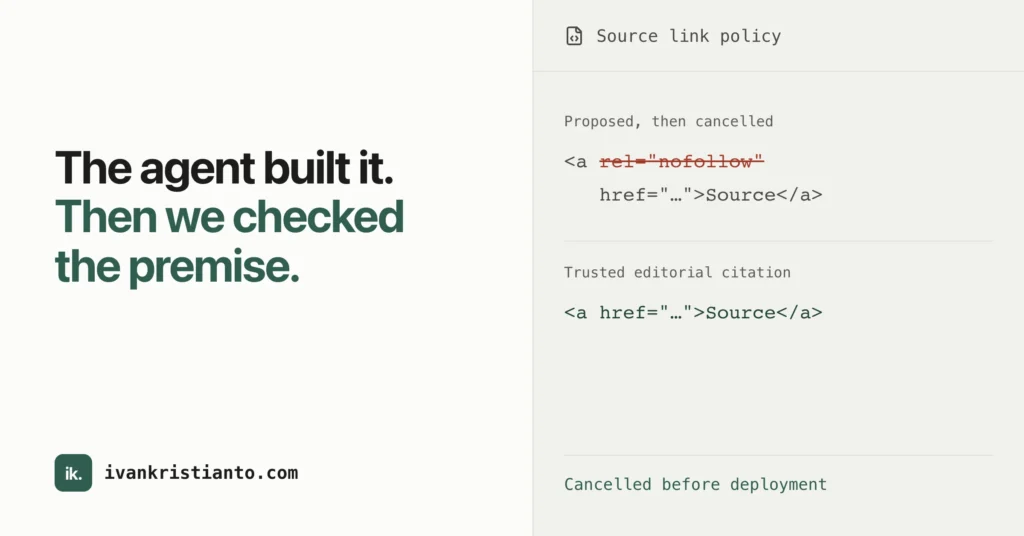
On November 8, 2026, I asked an AI coding agent to add rel="nofollow" to every link in my blog’s numbered Sources section. I thought outbound links might weaken my site’s SEO. The agent started building it, and the patch passed its local checks. Then it hit me that we needed to fact-check the reason for the change. My instruction came from obsolete SEO knowledge, and I cancelled the patch before it shipped.
The short version: trusted editorial citations can stay ordinary links. Google’s guidance explicitly advises against putting nofollow on every external link, and says relevant external references can help establish trustworthiness.1 I had asked the agent to automate a policy without checking whether the policy made sense.
The request started with the source links on my WebMCP article. They didn’t have nofollow, the link attribute used to qualify a link when you don’t want Google to associate your site with the destination.2 I took that absence as something to fix.
The agent agreed before checking the SEO premise. It implemented the change locally, including source links in hover previews, while keeping body links and the navigation back to citations alone. Its tests and PHP quality checks passed.
Those checks covered the implementation I’d requested. They didn’t tell us whether adding nofollow would improve anything. By the time I asked for evidence about SEO, there was already a working patch to throw away.
I don’t know exactly how much this detour cost me. Some time and some tokens. I’m writing it down because I supplied the outdated assumption and the agent carried on with it until I questioned it.
Google’s guidance changed my nofollow plan
The official documentation gave me a different default. For an ordinary link that you expect Google to fetch and parse without qualifications, you don’t need a special rel attribute.2 Being at the bottom of an article, under Sources, doesn’t change why I put the link there.
For a source I’m citing as evidence, an ordinary link looks like this:
<a href="https://example.com/docs">Documentation</a>That’s an illustrative link, not code from the discarded patch. The relationship is the part that matters. Google’s documentation recommends sponsored for advertisements and paid placements, and ugc for user-generated links such as comments or forum posts. It accepts nofollow for paid links too, though it prefers sponsored.2
<a href="https://example.com/paid" rel="sponsored">Sponsor</a>
<a href="https://example.com/comment" rel="ugc">Comment link</a>
For a link where those other values don’t apply and you don’t want Google to associate your site with the destination, nofollow remains an option.2 That could fit a page you’re discussing without endorsing it:
<a href="https://example.com/claim" rel="nofollow">A claim I dispute</a>I was about to apply that qualification to every source destination, including references I had chosen to support the article. The guidance didn’t give me a reason to qualify them all that way.
There’s another piece of old knowledge worth checking here. Google’s 2019 announcement describes nofollow, sponsored and ugc as hints about which links to consider or exclude within Search.3 These attributes aren’t an absolute guarantee that Google will never discover or crawl the destination; its current documentation says those pages can still be found through other links or sitemaps.2
That evidence was enough for me to cancel the blanket change. It doesn’t establish that my blog would gain rankings by leaving citations alone, or lose rankings if I added nofollow. I hadn’t run a ranking experiment, and the patch never reached production.
Why I left noarchive out too
During the same discussion, I also asked whether we should add noarchive. It’s a page-level robots directive, rather than a qualification on an individual outbound link. Putting rel="noarchive" on a citation doesn’t set a robots directive on the page it points to.4
Google now lists noarchive among historical rules it ignores. Its old purpose was to control the cached link in search results, and Google says that cached-link feature no longer exists.4 There wasn’t a Google SEO improvement here to add alongside the proposed link change.
Bing is a reason to avoid treating that as a universal statement. As checked on November 8, 2026, its guidelines say NOARCHIVE prevents content from being used in Copilot responses and grounding results, where web content informs an AI answer.5,6 That is a content-use restriction with a different purpose from qualifying an outbound citation.
Bing has also announced separate AI Training and AI Grounding preferences to replace those legacy controls for those uses. Its FAQ says it will begin honoring the new preferences as it crawls from February 1, 2027.6 Anyone who deliberately uses Bing’s old controls needs to read its transition guidance, rather than copy a tag from an old SEO checklist.
I left noarchive out and discarded the nofollow patch. There was no deployment or content rewrite, so I have no production SEO result to report.
If you’re asking an agent to make an SEO change across your site:
- State the benefit you expect and ask it to check that premise against current search-engine documentation.
- Check which relationship each link actually has before choosing a
relvalue. - Keep implementation checks separate from evidence of a ranking effect.
Sources
- 1 https://developers.google.com/search/docs/crawling-indexing/links-crawlable#external-links ↑
- 2 https://developers.google.com/search/docs/crawling-indexing/qualify-outbound-links a b c d e
- 3 https://developers.google.com/search/blog/2019/09/evolving-nofollow-new-ways-to-identify ↑
- 4 https://developers.google.com/search/docs/crawling-indexing/robots-meta-tag#noarchive a b
- 5 https://www.bing.com/webmasters/help/webmaster-guidelines-30fba23a ↑
- 6 https://www.bing.com/webmasters/help/new-ai-preferences-2t1cc16d a b