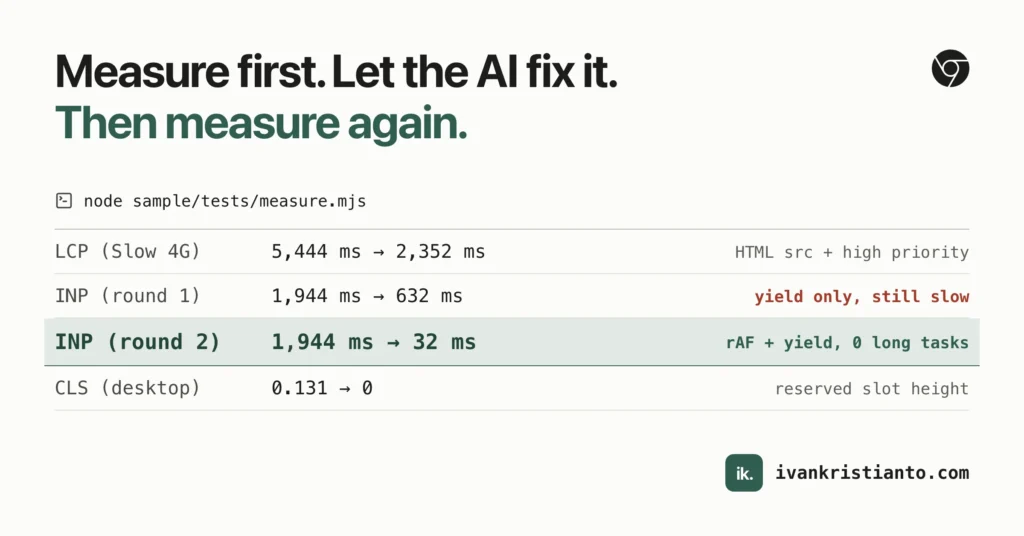
DevFest 2026 slides, PDF and the broken Core Web Vitals sample from my workshop are now online.1,2,3 Modern Web Guidance 1.0 gives an AI coding agent better advice, yet one fix still left the page slow until a second trace caught it.
The short version: I ran the same five-step loop for LCP, INP and CLS on a local copy of my podcast site. Measure in Chrome DevTools, ask Antigravity in Plan mode, check the plan, apply the diff and measure again.
I ran this 60-minute workshop live on November 25, 2026 for GDG Live Indonesia’s DevFest Live Indonesia 2026 Ep. 1, building on my Modern Web Guidance notes and my Claude Code long-task experiment.4 You can read the slides online or clone the repo to try all three cases on your own machine.1,3
The twist: following the guide still left INP at 632 ms
I built the workshop around a local copy of my podcast site, Ngobrolin WEB (9,982 transcript lines), with three isolated Core Web Vitals faults in sample/starter/.3 On November 15, 2026 I measured every variant across five fresh runs in headless Chromium 156.0.8078.4 via Playwright 1.64.1 at 4x CPU slowdown (plus Slow 4G for LCP, because localhost hides image discovery delay):5
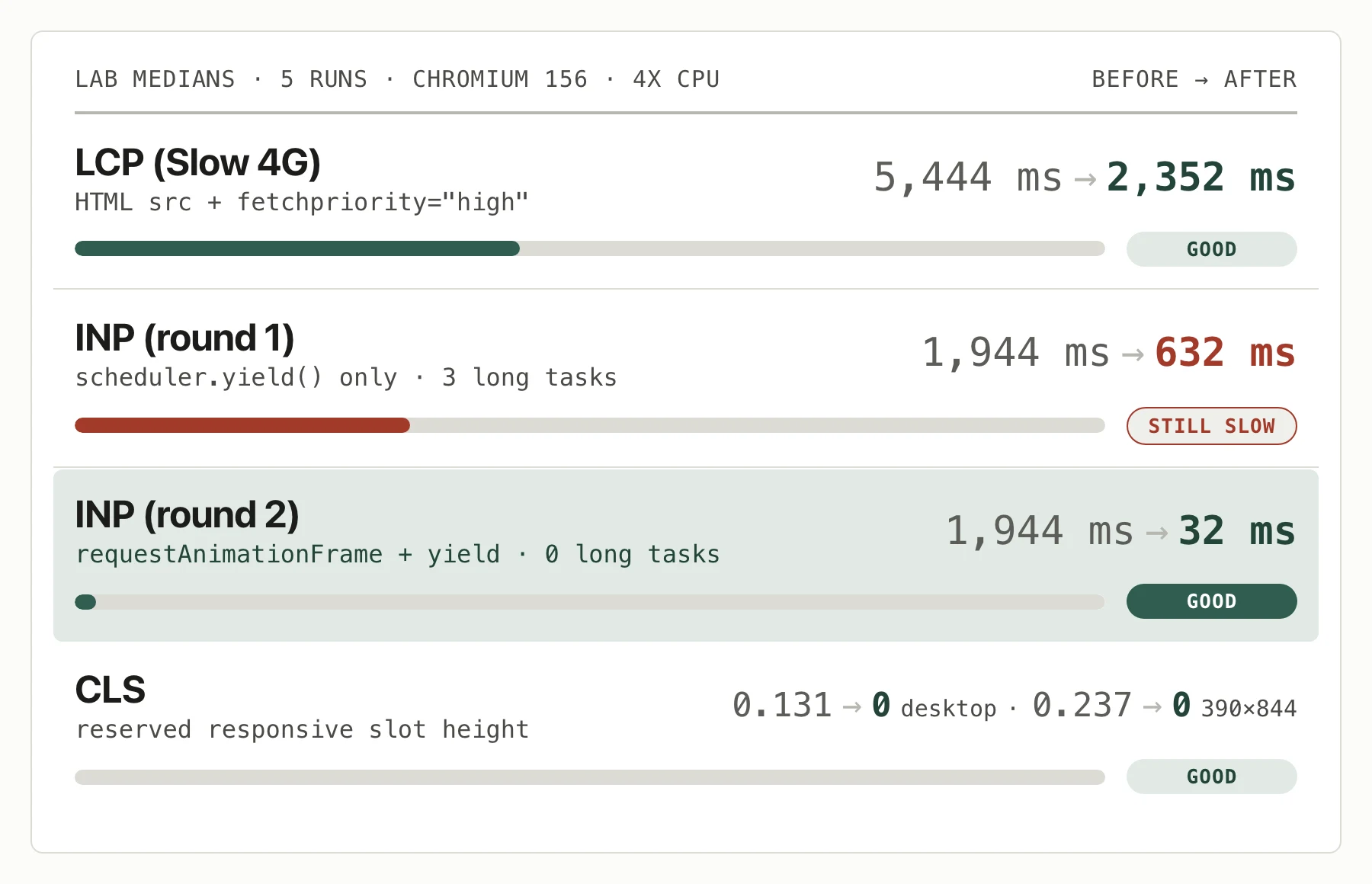
Case 2 is the part I wanted everyone to feel. The starter search code already yielded while building an HTML string, then dumped 1,686 matching rows into innerHTML at once.5
In round 1, the fix followed break-up-long-tasks by inserting 100-row batches with scheduler.yield(), yet typing "coding" still took 632 ms because batches piled into a 560 ms layout pass before the browser painted.5,6,7 Adding await nextFrame() (requestAnimationFrame) before yielding let the browser draw each batch and dropped worst interaction to 32 ms with zero long tasks.5,8
LCP and CLS hit the same lesson in different ways. For LCP, optimize-image-priority recommends fetchpriority="high", but priority alone couldn’t help while JavaScript assigned the hero src late, so the image had to move into HTML first.9 For CLS, measuring required a hands-off reload so DevTools wouldn’t ignore the shift, and fixing it meant reserving responsive space for the late announcement across desktop and phone widths.5,10
Running the Core Web Vitals loop on your own laptop
Everything runs offline on Node.js 22.12 or newer with Antigravity (Gemini 4 Hydrogen, or agy --mode=plan in the terminal), Modern Web Guidance 1.0 (203 guides, shipped November 10, 2026) and Chrome DevTools.11,12,13
- Clone the repository, install dependencies and add Modern Web Guidance:
git clone https://github.com/ivankristianto/google-devfest-2026.git
cd google-devfest-2026
npm ci
npx modern-web-guidance@latest install
agy plugin install https://github.com/GoogleChrome/modern-web-guidance
npm run sample:serve- Open
http://127.0.0.1:4173/starter/in Chrome, open the repo in Antigravity and followworkshop/prompts.md.12
I put an AGENTS.md file in the repo so the prompts stay short: it keeps edits inside sample/starter/, asks for a plan first and requires measuring before and after.14 Before clicking Proceed on any plan, check three things: does it fix what you measured, does the page still work the same, and does it name its guide? Each case also has a prepared folder under sample/reference/ if a run stalls.3
Every number above is a headless Chromium 156 lab measurement, not field Core Web Vitals (Google assesses real visits at the 75th percentile), and I haven’t measured total time to the last rendered search row or rerun the harness in headed Chrome.5,15
If you clone the repo, start with Case 2 and record round 1 before touching requestAnimationFrame. Watching a guide-backed fix stay slow is the quickest way to make recording twice a habit.
Sources
- 1 https://talks.ivankristianto.com/google-devfest-2026/ a b
- 2 https://talks.ivankristianto.com/google-devfest-2026/slidev-exported.pdf ↑
- 3 https://github.com/ivankristianto/google-devfest-2026 a b c d
- 4 https://gdg.community.dev/events/details/google-gdg-live-indonesia-presents-devfest-live-indonesia-2026-ep-1-measure-guide-fix-core-web-vitals-with-an-ai-agent/ ↑
- 5 https://github.com/ivankristianto/google-devfest-2026/blob/bda0ed752de08d1fcbea0427ae4ef6eac26bc493/evidence/measurements/summary.md a b c d e f
- 6 https://github.com/GoogleChrome/modern-web-guidance/blob/v1.0.0/skills/modern-web-guidance/guides/performance/break-up-long-tasks.md ↑
- 7 https://github.com/ivankristianto/google-devfest-2026/blob/bda0ed752de08d1fcbea0427ae4ef6eac26bc493/sample/reference/inp-yield-only/app.js ↑
- 8 https://github.com/ivankristianto/google-devfest-2026/blob/bda0ed752de08d1fcbea0427ae4ef6eac26bc493/sample/reference/inp/app.js ↑
- 9 https://github.com/GoogleChrome/modern-web-guidance/blob/v1.0.0/skills/modern-web-guidance/guides/performance/optimize-image-priority.md ↑
- 10 https://web.dev/articles/optimize-cls ↑Source 10 https://web.dev/articles/optimize-cls
- 11 https://github.com/GoogleChrome/modern-web-guidance/releases/tag/v1.0.0 ↑
- 12 https://github.com/ivankristianto/google-devfest-2026/blob/bda0ed752de08d1fcbea0427ae4ef6eac26bc493/workshop/prompts.md a b
- 13 https://antigravity.google/docs/cli/modes/ ↑
- 14 https://github.com/ivankristianto/google-devfest-2026/blob/bda0ed752de08d1fcbea0427ae4ef6eac26bc493/AGENTS.md ↑
- 15 https://web.dev/articles/vitals ↑Source 15 https://web.dev/articles/vitals